Energy Saver
Runs a hotel's boiler, EV charger and laundry in the cheapest hours of the day-ahead electricity market, and says in Telegram how much that saves.
- Role
- Solo project — design, code, tests
- Year
- 2026
- Category
- Infrastructure · Bots
- Stack
- Python 3.12, asyncio, FastAPI, Jinja2
The problem
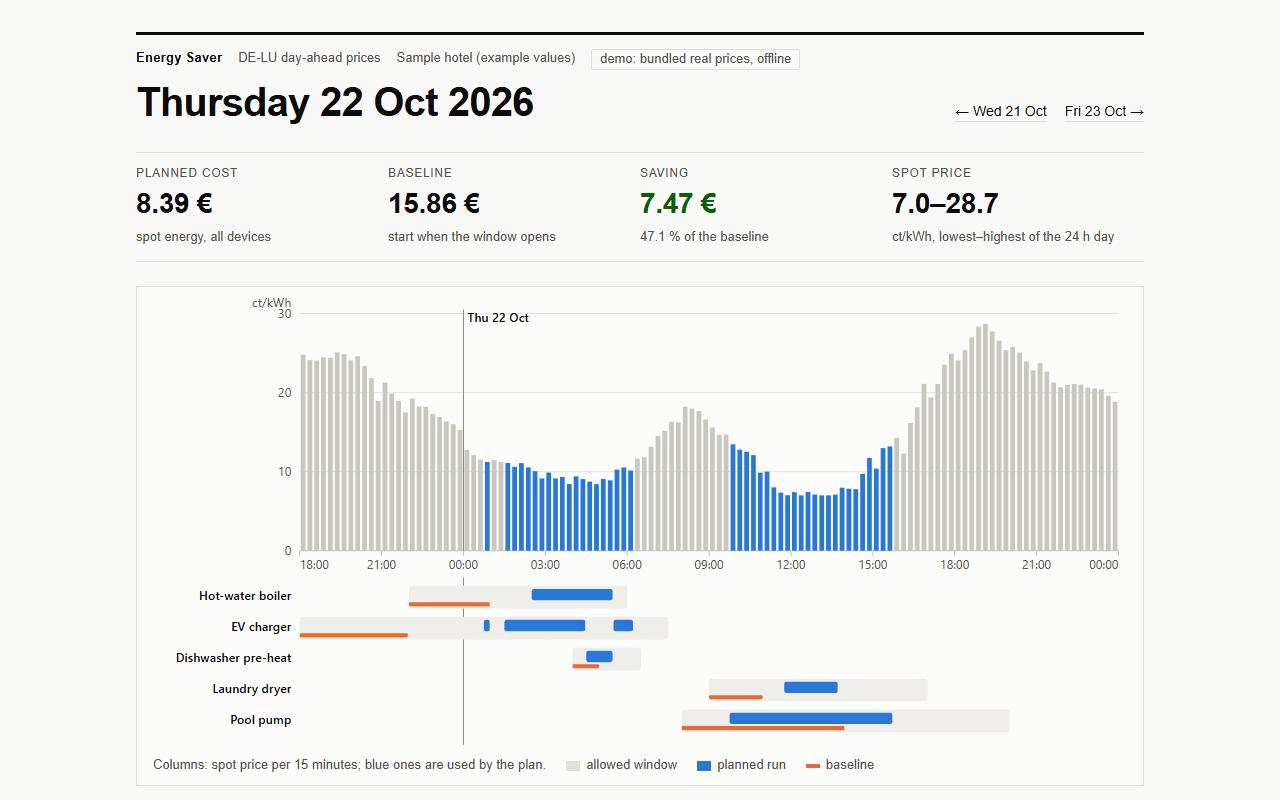
Under Article 11 of Directive (EU) 2019/944, EU countries must let every customer with a smart meter ask for a dynamic electricity price contract. On such a contract the energy part of the bill follows the day-ahead market, and since 1 October 2025 that market has a price for every 15 minutes. On an ordinary day in October 2026 the German price went from 7 to 29 cents per kWh.
A hotel or a café has loads that do not care when they run: a boiler with a big tank, a laundry dryer, an EV parked overnight, a pool pump. Moving them to the cheap hours saves money without new equipment, but nobody at reception will read a price curve every afternoon.
The solution
- Real prices come from the Energy-Charts API by Fraunhofer ISE (no token) and are cached in SQLite; the ENTSO-E Transparency Platform is an optional second source. Hourly and 15-minute prices are both handled.
- Each load is described in
devices.yaml: power, run time per day, allowed window (22:00-07:00), latest finish, one block or split with a minimum block length. - The planner picks the cheapest slots: a sliding window for one block, the k cheapest slots for a split run, and a small dynamic program when every block has a minimum length. A site power cap keeps the loads from overlapping too much.
- Every plan is compared with a naive schedule, where each device starts when its window opens. Money is
Decimal, so the saving in euros is exact. - Every afternoon a Telegram message gives tomorrow's plan with times and the expected saving. A web page shows the price chart and the plan per device.
- Shelly smart plugs can be switched through their local HTTP API. Dry run is the default: the request is logged, not sent.
Screenshots
Tech stack
- Python 3.12
- asyncio
- FastAPI
- Jinja2
- SVG
- aiogram 3
- SQLite
- httpx
- pytest
All prices go onto one 15-minute grid: an hourly price becomes four equal slots, so the planner never needs to know which kind it got. The chart is inline SVG drawn on the server, with real time on the x axis, so a 25-hour day is wider. The demo works offline on 36 days of real prices that I downloaded once and bundled with their source and licence (CC BY 4.0, Bundesnetzagentur | SMARD.de).
Code highlight
Windows are in local time, prices are in UTC. A window that crosses midnight belongs to the
day it ends on, so tonight's boiler run is planned together with tomorrow's prices. Each
wall-clock time is converted on its own day, which makes the same 22:00-07:00 window
8 hours long when the clocks go forward and 10 hours long when they go back:
def _local(day: date, minute: int, tz: ZoneInfo) -> datetime:
    day = day + timedelta(days=minute // 1440)
    minute %= 1440
    local = datetime.combine(day, time(minute // 60, minute % 60), tzinfo=tz)
    return local.astimezone(UTC)


def window_bounds(device: Device, day: date, tz: ZoneInfo) -> tuple[datetime, datetime]:
    spec = device.spec  # start_day_offset is -1 when the window crosses midnight
    start_day = day + timedelta(days=spec.start_day_offset)
    return _local(start_day, spec.start_minute, tz), _local(start_day, spec.end_minute, tz)
Bug I found and fixed
"-0.00 €" on a day with negative prices
What broke
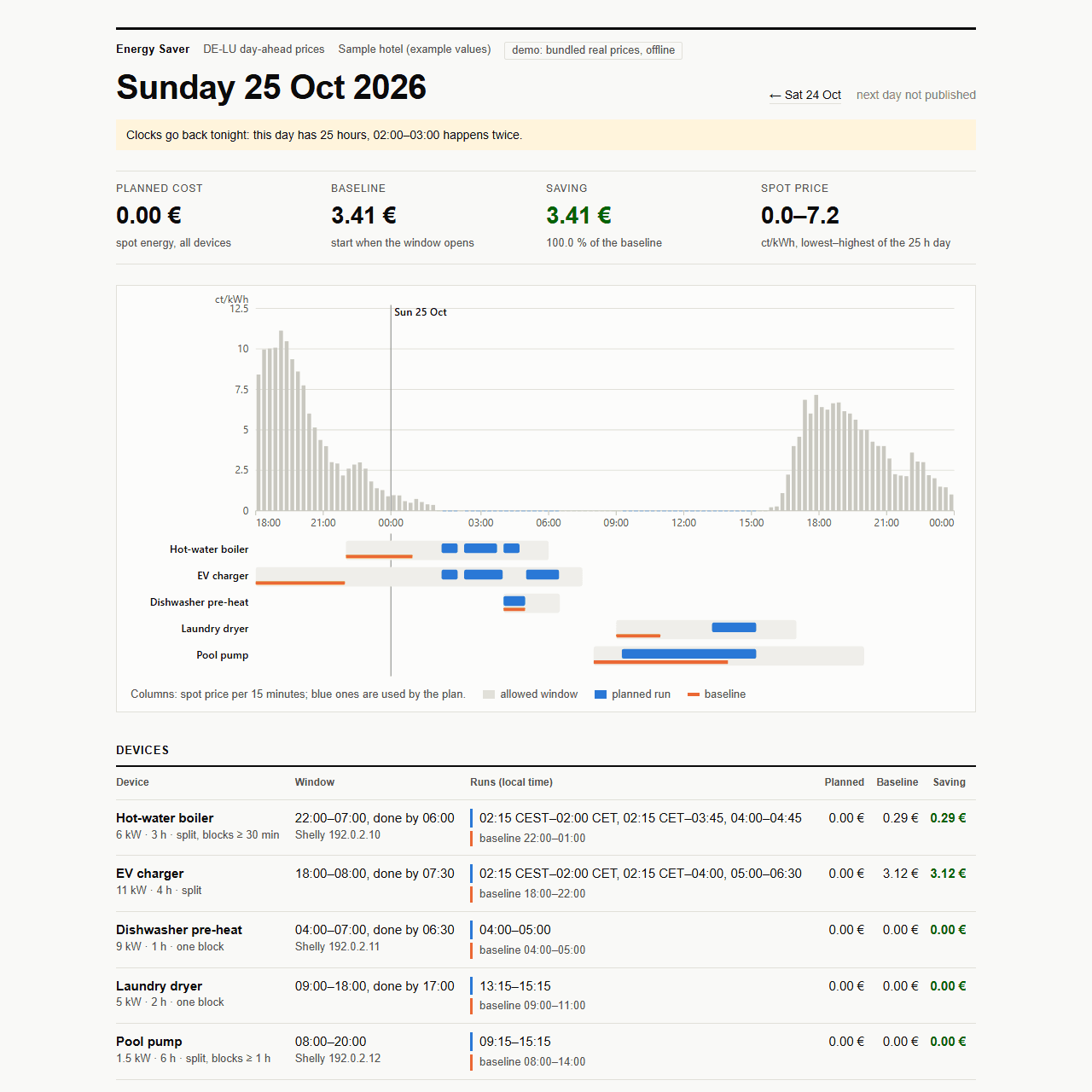
The first demo run printed tomorrow's plan with -0.00 € instead of 0.29 € for the boiler
and Expected cost -0.00 € for the whole day. The page showed the lowest price as -0.0.
Root cause
25 October 2026 was a windy Sunday: the German price sat at 0.00 or -0.01 EUR/MWh from
02:00 to 16:00. The planner correctly chose the -0.01 slots, so the boiler would have been
paid 0.00003 €. Decimal.quantize keeps the sign of a number that rounds to zero, and so
does float formatting.
The fix
One rounding helper for money and one for cents per kWh: a value that rounds to zero loses its sign, while a real negative amount still prints with a minus. The test uses the real cost of one of those slots.
def money(value: Decimal | None) -> str:
    if value is None:
        return "—"
return f"{value.quantize(CENT, ROUND_HALF_UP):.2f} €"def cents(value: Decimal) -> Decimal:
rounded = value.quantize(CENT, ROUND_HALF_UP)
return abs(rounded) if rounded == 0 else rounded
def money(value: Decimal | None) -> str:
return "—" if value is None else f"{cents(value):.2f} €"Result
- 108 automated tests, including real price files for both DST days (hourly and 15-minute), the switch from hourly to 15-minute prices, and the dynamic program checked against brute force.
- Backtest on 30 days of real German prices (26 September to 25 October 2026) with five sample devices: 4.88 € saved per day, 29.6 % of the spot cost, 146.47 € over the month.
- The demo runs offline with no keys; the backtest takes a few seconds.