Hotel AI Concierge
A Telegram concierge that answers guests in four languages from the hotel's own facts — and hands everything else to reception.
- Role
- Solo project — design, code, tests
- Year
- 2026
- Category
- AI · Bots
- Stack
- Python 3.12, aiogram 3, Anthropic API, OpenAI API
The problem
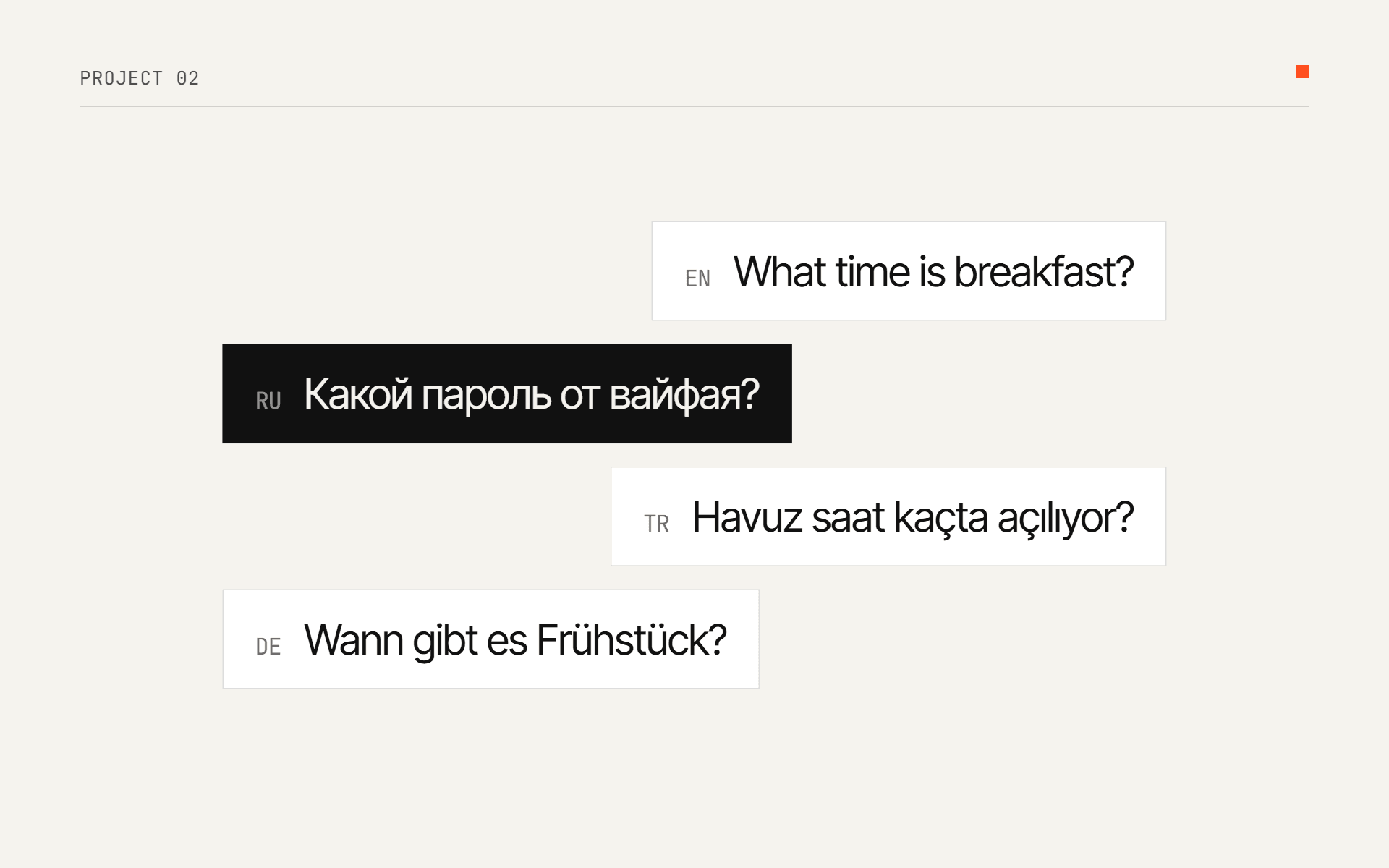
The reception desk answers the same questions all day: breakfast hours, the Wi-Fi password, when the pool opens, how to book a transfer. In a resort hotel in Turkey guests ask them in Russian, English, Turkish and German, and the staff do not speak all four.
A plain chatbot is risky here. An AI that invents a check-out time or a price causes real trouble at the desk, and the guest blames the hotel, not the bot.
The solution
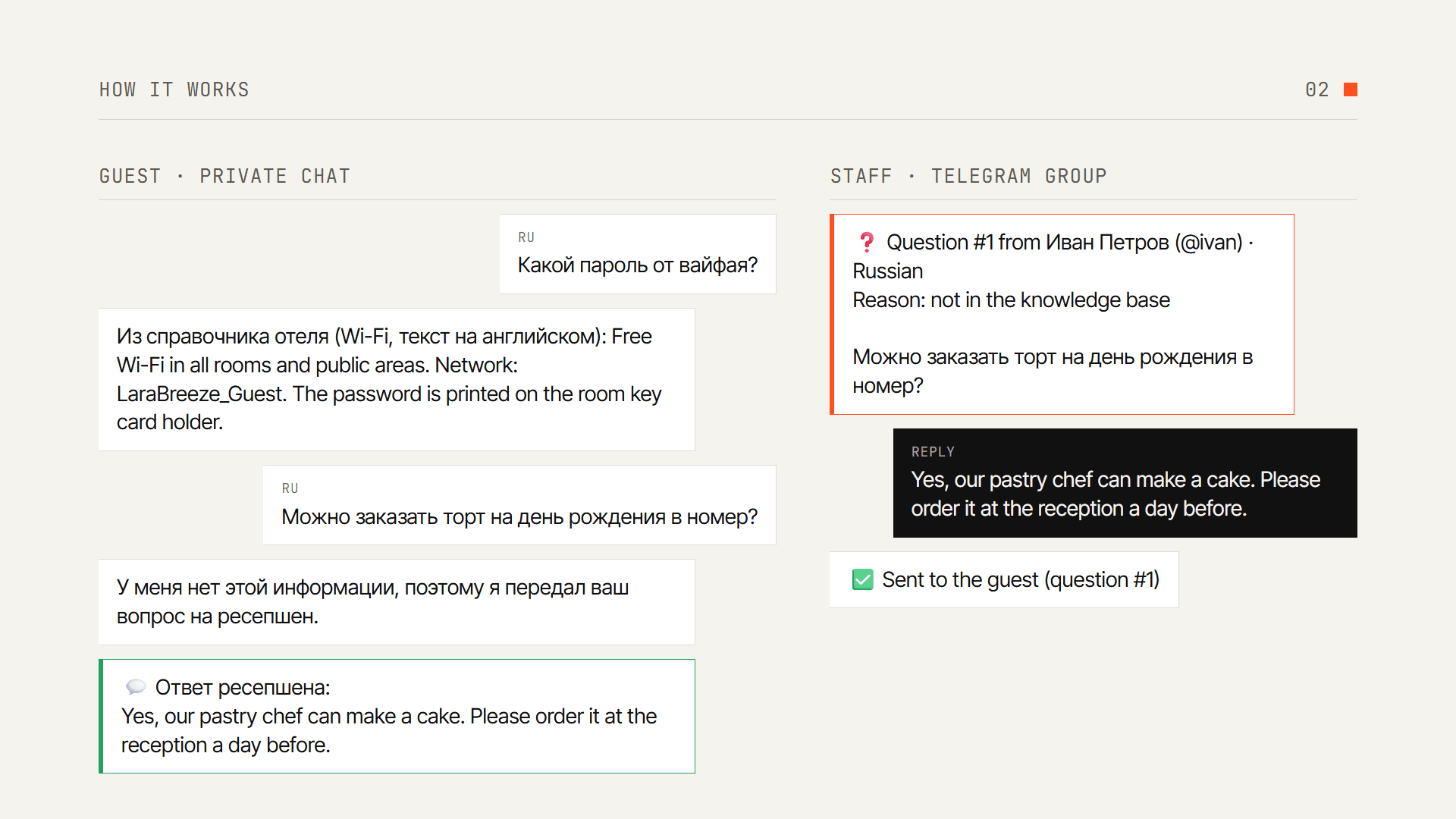
A Telegram bot that answers only from facts the hotel wrote down, and asks a person about everything else:
- The knowledge base is one Markdown file the hotel edits.
/reloadapplies changes without a restart; a broken file keeps the old version. - The language model (Claude or OpenAI, chosen in the settings) returns structured JSON with a
found_in_knowledge_baseflag, so "do I know this?" is a yes/no value, not a guess from the model's wording. - Unknown questions go to a staff Telegram group with an English translation. Staff simply press Reply; the bot translates the answer into the guest's language and shows the original below.
- The guest's language is detected without AI: alphabet, letters such as ı ş ğ or ä ß, and common words. Short messages like "ok" keep the language of the conversation.
- Every failure ends with a person: API down, model refusal or a cut-off answer go to staff; if the staff group cannot be reached, the guest is told to ask at the desk.
Demo
Screenshots
Tech stack
- Python 3.12
- aiogram 3
- Anthropic API
- OpenAI API
- SQLite
- pytest
- Docker
The whole knowledge base goes into the prompt instead of a vector search: a hotel FAQ is a few thousand tokens, so retrieval would only add a new way to fail. Because that prompt never changes between guests, Anthropic caches it and repeated requests cost less. An offline mock model lets the whole flow run without an API key.
Code highlight
The core decision, independent of Telegram, so the bot, the terminal demo and the tests all run the same code:
async def handle_guest_message(self, guest: Guest, text: str) -> GuestReply:
    language = await self.guest_language(guest, text)
    history = format_history(
        await self._repo.recent_messages(guest.chat_id, self._settings.history_messages)
    )
    await self._repo.upsert_guest(guest.chat_id, guest.name, guest.username, language)
    await self._repo.log(guest.chat_id, Role.GUEST, Kind.QUESTION, text, language)

    result: ConciergeAnswer | None = None
    try:
        result = await self._llm.answer(text, language, self._knowledge.text, history)
    except LLMError as exc:
        logger.warning("LLM failed, escalating to staff: %s", exc)

    if result and result.found_in_knowledge_base and result.answer.strip():
        answer = result.answer.strip()
        await self._repo.log(guest.chat_id, Role.BOT, Kind.ANSWER, answer, language)
        return GuestReply(language, answer)

    # Not in the knowledge base, or the AI is unavailable: never guess, ask a human.
    reason = "not in the knowledge base" if result else "AI assistant unavailable"
    question_en = result.question_in_english if result else text
    escalation_id = await self._repo.create_escalation(
        guest.chat_id, language, text, question_en, reason
    )
    ...
Bug I found and fixed
Guest commands were sent to the AI and to reception as questions
What broke
Nothing crashed, and the test passed. While writing an end-to-end test for the admin command
/reload, I traced what happens when a guest sends it. The bot paid for an AI call, found
nothing in the knowledge base and posted "/reload" to the staff group as a guest question. The
same happened to /help or any other command.
Root cause
aiogram checks handlers in registration order and uses the first one whose filters match. The admin-only handler correctly ignored the guest, so the message fell through to the catch-all handler, which treats any text as a question.
The fix
A handler for commands in private chats, registered before the catch-all, shows the welcome text instead. The test now checks both sides: the guest gets the welcome text, and nothing reaches the staff group. Lesson: a test that only checks "the bad thing did not happen" can pass for the wrong reason.
router.message.register(on_staff_reply, IsStaffChat(), F.reply_to_message, F.text)
router.message.register(on_guest_text, private, F.text)
router.message.register(on_guest_other, private)router.message.register(on_staff_reply, IsStaffChat(), F.reply_to_message, F.text)
# /help or a command the guest may not use: show the welcome text, do not ask the LLM.
router.message.register(cmd_start, private, F.text.startswith("/"))
router.message.register(on_guest_text, private, F.text)
router.message.register(on_guest_other, private)Result
- 68 automated tests, including a run through aiogram's dispatcher with a fake Telegram connection, and tests of the Claude and OpenAI clients against a fake HTTP server.
- The offline demo answers four scripted guests in four languages, sends the fifth question to staff, and delivers the staff reply back.
- Runs without any API key in demo mode.