Helpdesk Copilot
An IT assistant that answers employees from the company's own how-tos with numbered sources, and turns everything else into a triaged ticket.
- Role
- Solo project — design, code, tests
- Year
- 2026
- Category
- AI · Bots
- Stack
- Python 3.12, Anthropic API, BM25, aiogram 3
The problem
In a small company the IT department is one person, or an outside provider paid by the hour. A large part of their day is the same twenty questions: the guest Wi-Fi password, the VPN from home, a stuck print job, MFA on a new phone. The answers are usually written down somewhere, and nobody reads them.
A general chatbot answers these confidently and wrongly. It does not know this company's network names, extensions or rules, and people do what an IT assistant tells them. This is a common first AI project for small companies and IT service providers, so I wanted to build it properly: answers only from the company's own how-tos, a visible source for every sentence, a measured evaluation, and a person for everything else.
The solution
- The knowledge base is a folder of Markdown how-tos, one
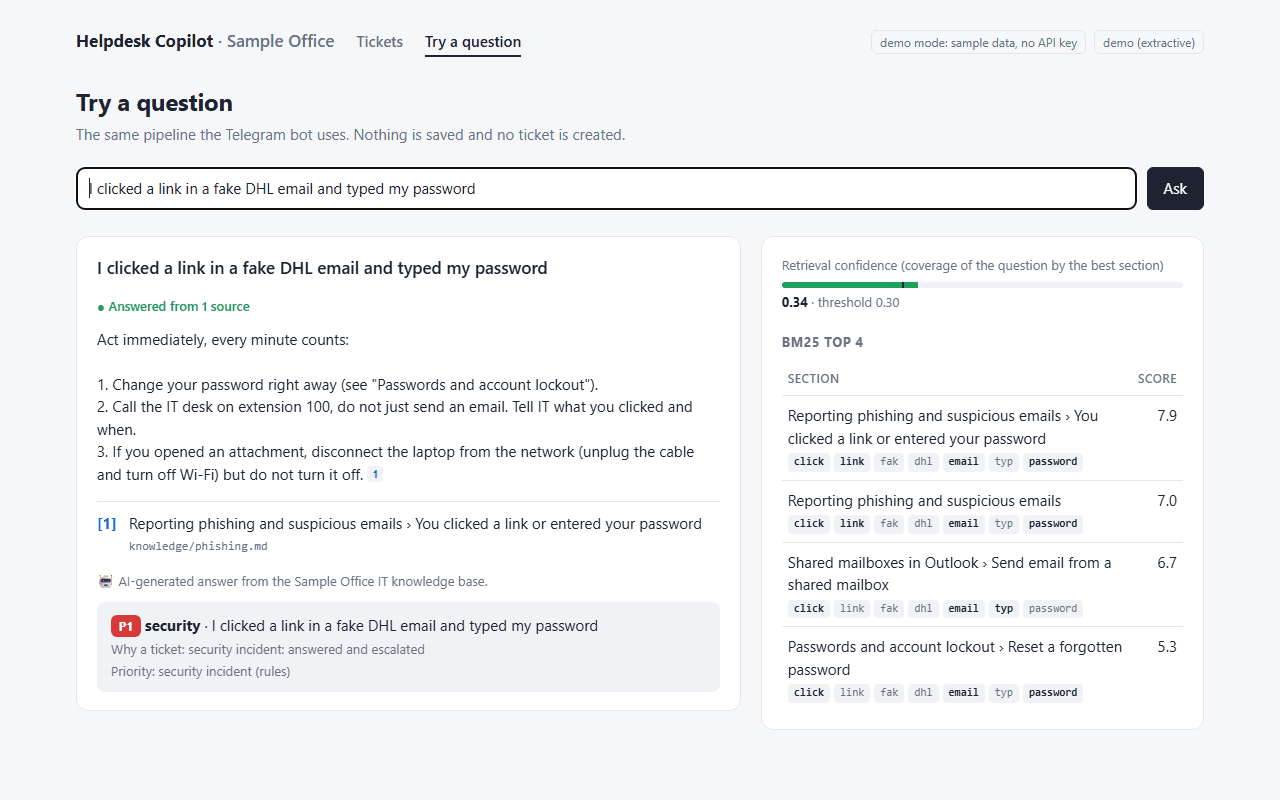
## Sectionper task. For the demo I wrote 15 of them for a fictional "Sample Office": Wi-Fi, guest Wi-Fi, VPN, printers, passwords, MFA, shared mailboxes, phishing, backups and more. - Search is BM25 over sections, with no ML libraries. Light normalization (no accents, simple stemming, a small German/Russian/Turkish glossary of IT words) lets "Mein Druckauftrag hängt" find the English "Print job is stuck" section.
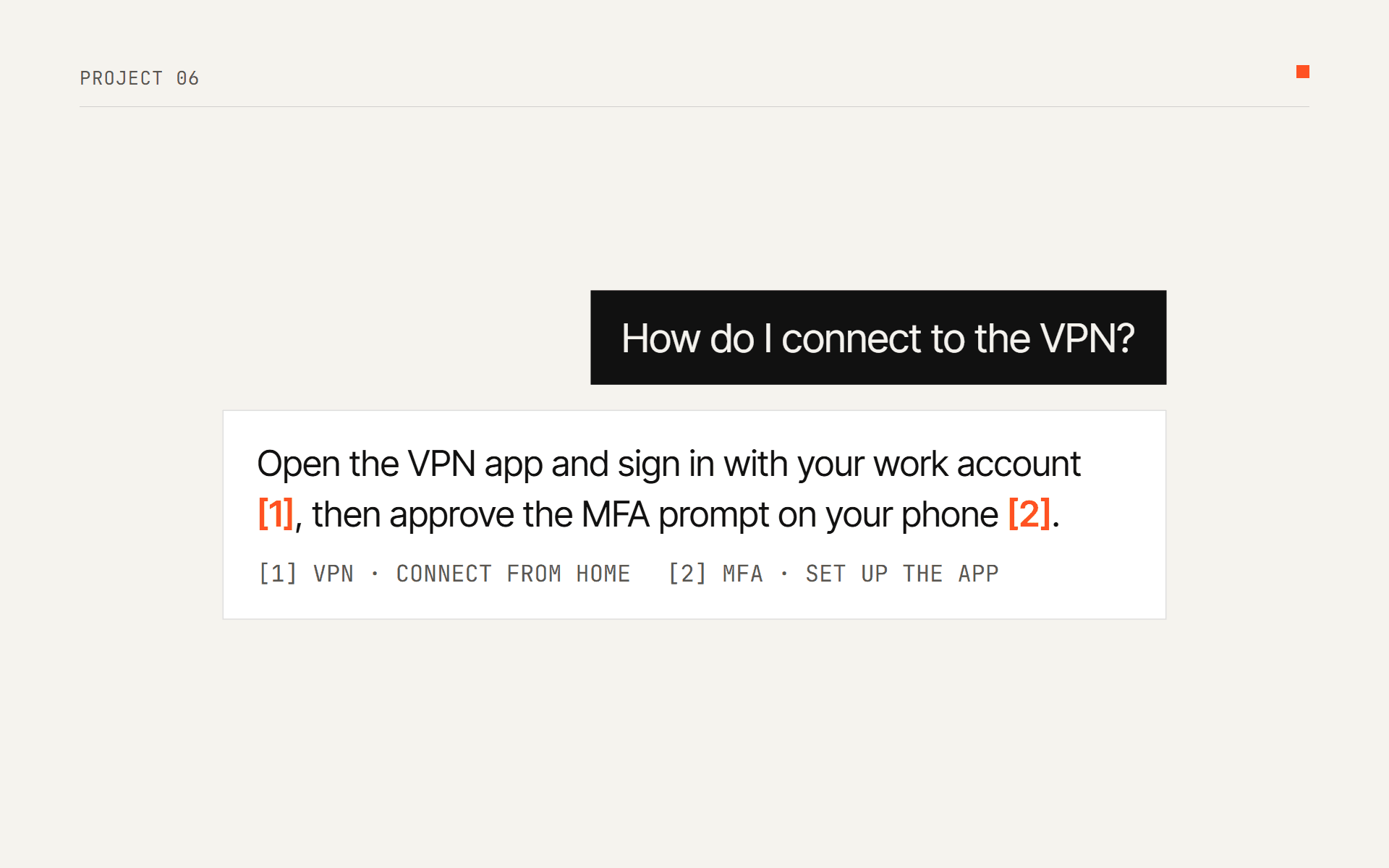
- Claude answers only from the retrieved sections and cites them as [1], [2]. The code checks every citation; an answer without a valid source is never shown.
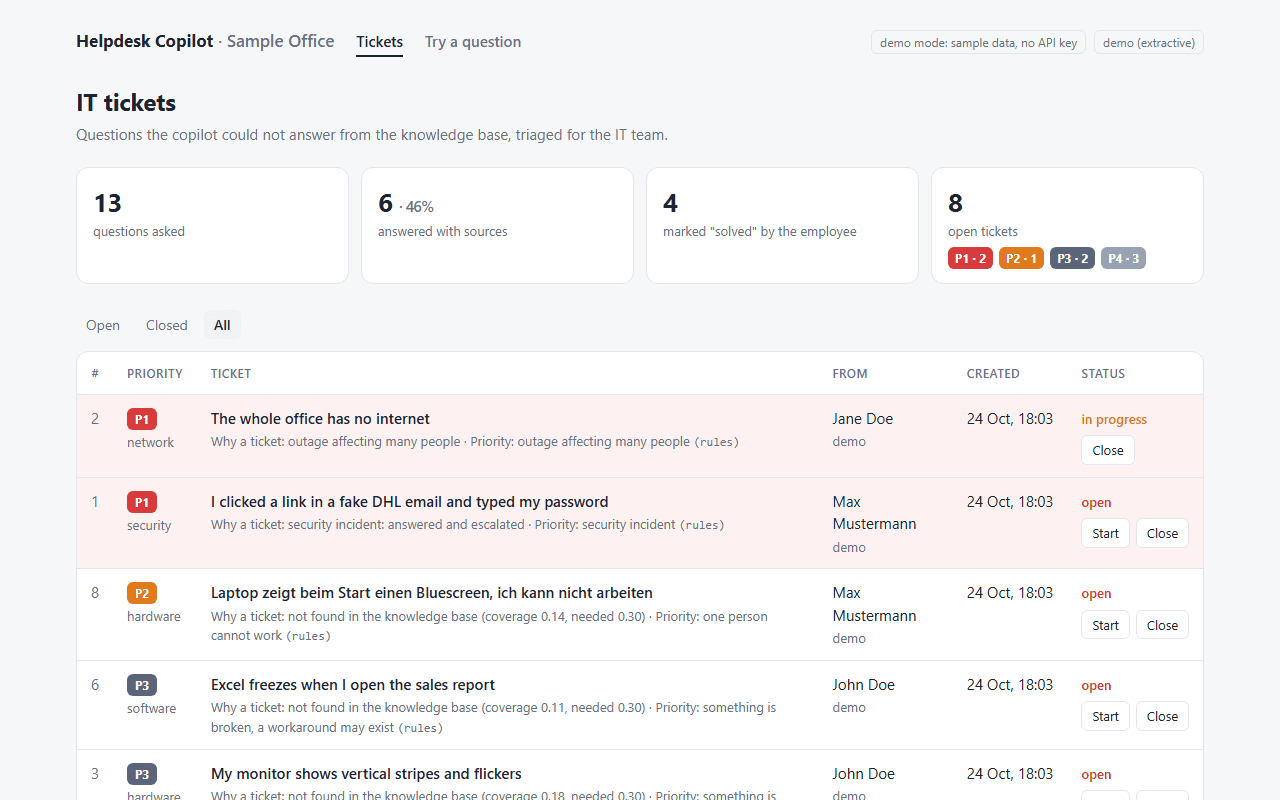
- Anything it cannot answer becomes a ticket with a category, a priority from P1 to P4 and a one-line summary. Phishing and an office-wide outage are always P1, and the model cannot lower that.
- In Telegram the employee gets the answer with sources and two buttons: Solved or Create ticket. New tickets go to the IT chat; the IT person works through them on a small web page.
- The bot says it is an AI in
/startand under every answer, as Article 50 of the EU AI Act requires for systems that talk to people.
Screenshots
Tech stack
- Python 3.12
- Anthropic API
- BM25
- aiogram 3
- FastAPI
- Jinja2
- SQLite
- pytest
BM25 instead of embeddings: for a few dozen pages it is fast (under 0.2 ms per question), needs no model or vector database, and its decisions can be shown on screen. The cheapest checks run first, so a question the how-tos cannot support becomes a ticket without any paid API call. Without an API key the app runs in demo mode: it quotes the best section and triages by rules.
Code highlight
The whole decision, independent of Telegram, so the bot, the web page, the evaluation and the tests run the same code:
async def decide(self, question: str) -> Decision:
    retrieval = self.retriever.search(question, self.top_k)
    urgent = urgency(question)

    if urgent is Urgency.OUTAGE:
        return Decision(retrieval, route=Route.OUTAGE)
    if is_action_request(question):
        return Decision(retrieval, route=Route.ACTION)
    if not retrieval.confident:  # no LLM call for what the how-tos cannot support
        return Decision(retrieval, route=Route.NOT_FOUND)

    sources = number_sources([hit.section for hit in retrieval.hits])
    try:
        draft = await self.llm.answer(question, sources)
    except LLMError:
        draft = await self.fallback.answer(question, sources)  # extractive, still grounded

    if not draft.answered or not draft.answer.strip():
        return Decision(retrieval, route=Route.NO_ANSWER)
    check = check_citations(draft.answer, sources)
    if not check.grounded:
        return Decision(retrieval, route=Route.NO_CITATION)

    route = Route.SECURITY if urgent is Urgency.SECURITY else None
    return Decision(retrieval, check.text, check.cited, route=route)
Bug I found and fixed
"The whole office has no internet" was filed as an access problem
What broke
When I ran the triage rules over the evaluation questions, the office-wide outage got the right priority, P1, but the category access, next to password resets. A question about internet for workshop guests ended up in the same place.
Root cause
Keywords are matched at the start of a word, so that "phish" also finds "phishing" and "Phishing-Mail". The access keyword "intern" (accounts for interns) therefore also matched "internet", and when two categories tied, access was checked before network.
The fix
A keyword can now require a whole word with a trailing $, and "intern" became "intern$".
Network also wins a tie over access now. A test checks "No internet on my laptop" (network)
next to "Account for our new intern" (access).
folded = fold(phrase.strip())
parts.append(part + r"\b" if len(folded) <= 3 else part)

ACCESS = keywords("... contractor, intern, passwort, ...")folded = fold(phrase.strip())
whole = folded.endswith("$") or len(folded) <= 3
folded = folded.rstrip("$")
parts.append(part + r"\b" if whole else part)
ACCESS = keywords("... contractor, intern$, passwort, ...")Result
- 110 automated tests: ranking, citation checks, every path to a ticket, triage rules, the Claude client against a fake API server, and the Telegram bot end to end with a fake Telegram session.
- Search on 30 test questions in four languages: the right document comes first in 29 of 30 and is in the top three in 30 of 30. On 15 held-out questions, scored once at the end: 14 of 15 and 15 of 15.
- All 13 questions the how-tos do not cover became tickets in the evaluation. The README also lists three that slipped through while I prepared the demo, and why.
- Answer quality with Claude is not measured yet; that needs an API key. [Claude evaluation numbers]